 English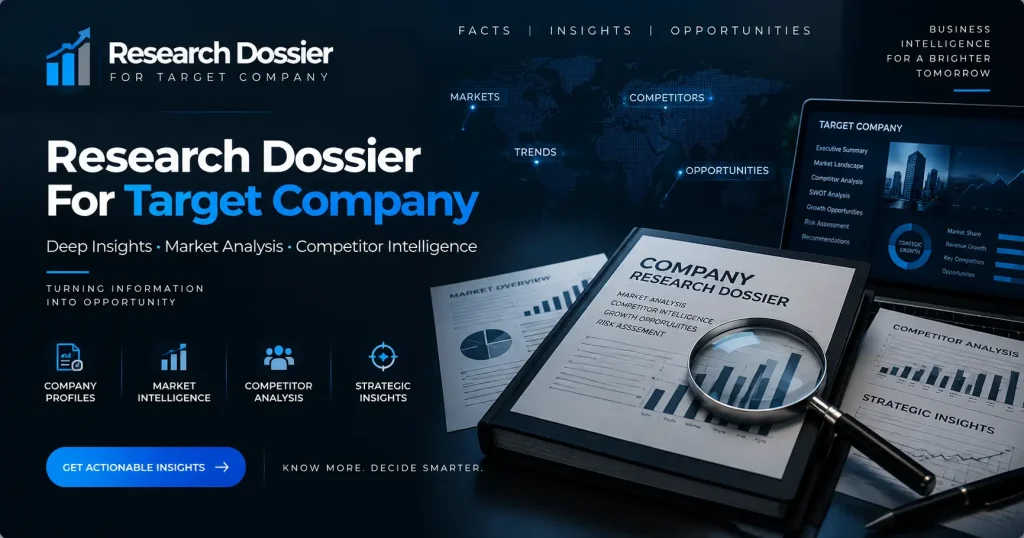































































































































































































































































































































































































![swimsuit edition [abbb] - 1.20 21 swimsuit edition - chapter](https://mymagazine.blog/wp-content/uploads/2025/09/swimsuit-edition-abbb-1.20-21-swimsuit-edition-chapter1-1024x574.webp)





Research Dossier for Target Company: Complete Research Framework

When a business decision carries real consequences, a quick Google search is rarely enough.
A company may have a polished website, an impressive product portfolio, a growing social media presence, or an attractive sales presentation. None of those things alone provides a complete picture of the organization. To understand a business properly, researchers need to look beyond the surface and organize information from multiple areas into one coherent picture.
That is where a research dossier for target company becomes useful.
A target company research dossier is a structured document designed to bring together the most important information about a particular business. Depending on the purpose of the research, it can examine the company’s background, ownership, leadership, products, customers, business model, financial position, competitors, technology, market environment, reputation, risks, opportunities, and important unanswered questions.
The strength of a dossier is not simply its length. A 50-page document filled with disconnected facts may be less useful than a carefully organized report that answers the questions that actually matter.
A strong dossier helps the reader understand not only what the company says about itself, but also what can be established about the business, where uncertainty remains, and what deserves further investigation.
Research Dossier for Target Company at a Glance
| Research Area | What the Dossier Examines |
|---|---|
| Company Identity | Name, industry, location, structure, and business purpose |
| Company History | Founding, milestones, expansion, acquisitions, and major changes |
| Ownership | Founders, shareholders, parent companies, and control |
| Leadership | Executives, directors, management responsibilities, and experience |
| Products & Services | Main offerings, pricing structure, differentiation, and customers |
| Business Model | How the company creates value and generates revenue |
| Financial Position | Revenue, profitability, funding, assets, liabilities, and trends |
| Market | Industry conditions, demand, competitors, and market position |
| Technology | Platforms, infrastructure, software, intellectual property, and innovation |
| Reputation | Customer feedback, public perception, brand presence, and notable issues |
| Risks | Financial, operational, legal, competitive, technological, and market risks |
| Opportunities | Expansion, products, partnerships, technology, and market opportunities |
| Evidence | Information that can be verified and areas that remain uncertain |
What Is a Research Dossier for Target Company?
A research dossier for target company is a detailed research document created around one specific business.
The phrase target company simply means the organization being investigated. It does not necessarily refer to a particular company called Target. A target company can be a startup, private business, public corporation, technology company, manufacturer, agency, retailer, supplier, potential client, competitor, acquisition candidate, or prospective business partner.
A basic company profile usually provides introductory information.
It might tell you the company’s name, headquarters, industry, products, executives, and founding history.
A research dossier goes considerably further.
It attempts to connect those basic facts with the company’s operations, ownership, financial condition, competitive environment, customers, technology, reputation, risks, and future possibilities.
That distinction is important because business research is rarely about collecting facts for their own sake.
The purpose is usually to answer a practical question.
Should a company become a potential client?
Is it worth approaching for a partnership?
How does it compete?
What does its financial position look like?
Who controls the business?
What products drive its growth?
What risks could affect the organization?
What information is still missing?
A good dossier is built around those questions.
Why a Target Company Research Dossier Matters
Company information is often scattered.
One page may explain the company’s history. Another may contain leadership information. Financial details might appear in reports, filings, presentations, or databases. Product information may be spread across several sections of the company’s website.
Competitor information usually exists somewhere else entirely.
This creates a problem.
A researcher can collect dozens of interesting facts without developing a clear understanding of the business.
A dossier solves this by giving the research a structure.
Instead of keeping isolated notes, the researcher places information into connected categories. The company history provides context for current operations. Leadership information explains who makes important decisions. Product research reveals what the business sells. Financial information provides another view of performance. Competitor research places the company within its market.
The result is more than a collection of facts.
It becomes a working business intelligence document.
Start With the Research Objective
The first mistake many people make is beginning research before deciding what they are trying to discover.
A dossier should begin with a clear objective.
The information needed to evaluate a potential supplier is different from the information required to prepare for an investment decision.
A sales team researching a potential customer may care about company size, decision-makers, expansion plans, products, technology, and likely business challenges.
An investor may focus heavily on financial performance, ownership, profitability, debt, market conditions, and long-term risks.
A competitor analysis may emphasize pricing, products, positioning, technology, marketing, distribution, and customer segments.
An acquisition investigation requires a much deeper level of analysis.
Therefore, there is no single perfect research dossier for every situation.
The strongest approach is to define the decision first and then collect the information necessary to support it.
Building the Company Identity Section
Every dossier should establish exactly which company is being researched.
This sounds obvious, but company identity can become surprisingly complicated.
Businesses can have a trading name that differs from their legal name. A company may operate several brands. A parent organization may own multiple subsidiaries. A website may represent a regional division rather than the entire corporation.
The identity section should therefore establish the basic organizational picture.
Important details can include the official company name, trading name, website, industry, headquarters, operating regions, legal structure, founding period, parent company, subsidiaries, and principal business activities.
The purpose is not to fill a table with unnecessary information.
It is to prevent the entire dossier from being built around the wrong entity.
Company History and Major Milestones
A company’s present position is often easier to understand when its history is clear.
The history section should focus on developments that changed the business rather than attempting to document every minor event.
Important milestones may include the company’s founding, launch of major products, entry into new markets, acquisitions, mergers, major funding events, leadership changes, restructuring, significant partnerships, and strategic shifts.
History also provides context.
For example, a company that recently expanded internationally should be viewed differently from one that has operated across multiple markets for decades.
A business that transformed from a small startup into a large organization may have a very different operational structure from a company that has always operated at scale.
The objective is to understand how the current organization developed.
Ownership and Corporate Structure
Ownership is one of the most important parts of serious company research.
A business may be privately owned, publicly traded, controlled by founders, backed by institutional investors, owned by a parent organization, or structured through several subsidiaries.
Understanding ownership can clarify who has influence over major decisions.
For public companies, ownership information may be relatively accessible. Private businesses can require more careful research because detailed shareholder information may not always be publicly available.
A strong dossier should distinguish confirmed ownership information from assumptions.
If the ownership structure is complicated, a simple organizational diagram can also help explain the relationship between the parent company, subsidiaries, brands, and other entities.
Leadership and Decision-Makers
The leadership section identifies the people responsible for directing the organization.
Depending on the company, this may include founders, chief executives, directors, financial leaders, technology executives, operating executives, and other senior decision-makers.
But listing names is only the beginning.
A useful dossier connects leadership roles with responsibilities.
Who oversees product development?
Who controls financial strategy?
Who manages operations?
Who is responsible for technology?
Who leads sales or marketing?
These questions can become particularly important when the dossier is being created for sales, partnerships, investment research, or competitive intelligence.
Leadership changes should also be tracked because they can signal changes in company direction.
Products and Services
A company cannot be properly understood without understanding what it actually sells.
The products and services section should identify the organization’s primary offerings and explain what problem each one is intended to solve.
The research can examine product categories, target customers, pricing structures, distribution channels, subscription models, enterprise offerings, physical products, digital services, and additional revenue-generating services.
It is also useful to separate core products from secondary offerings.
A company may advertise dozens of products while relying heavily on only a small number of them commercially.
Understanding that distinction can reveal much more about the business model.
Understanding the Business Model
The business model explains how the company turns its activities into economic value.
This is one of the sections where a dossier becomes more useful than a simple company profile.
Knowing what a business sells is not enough.
You also want to understand who pays for it, how customers are acquired, how frequently they purchase, how the company delivers its offering, and which activities are essential to generating revenue.
Different businesses can operate very differently.
A software company might use recurring subscriptions.
A marketplace may earn commissions.
A manufacturer may rely on product sales and distribution partners.
An agency may generate revenue from professional services.
A media company may combine advertising, subscriptions, sponsorships, and partnerships.
The business model should therefore be described in practical terms rather than vague corporate language.
Customer and Audience Research
A company’s customers tell you a great deal about its business.
The dossier should identify the major customer groups where information is available.
These could include consumers, small businesses, enterprises, government organizations, developers, retailers, manufacturers, or other specialized audiences.
The research can also examine geography and customer concentration.
Does the company depend heavily on one region?
Does it serve a global audience?
Does it appear to rely on a small number of major customers?
Does it target a narrow industry?
Customer concentration can be particularly important because dependence on a limited customer base can create a different risk profile from a company serving millions of independent customers.
Financial Research
Financial analysis is often one of the deepest sections of a target company dossier.
The exact information available depends heavily on whether the company is public or private.
For a public organization, researchers may be able to examine revenue, operating income, net income, cash flow, assets, liabilities, debt, capital expenditures, and other financial indicators.
For private companies, the picture can be less complete.
Instead of filling missing information with estimates presented as facts, a good dossier should clearly identify what is known and what remains unavailable.
Financial information should always be connected to a time period.
A revenue number without a year or reporting period is difficult to interpret.
The same applies to employee counts, funding totals, market share, and other changing statistics.
Dates turn isolated numbers into meaningful information.
Revenue and Growth Analysis
Revenue is one of the most visible business metrics, but it should not be interpreted in isolation.
A company can increase revenue while facing higher expenses.
It can grow quickly while requiring significant additional investment.
It can report strong sales from one product while other areas decline.
Therefore, a research dossier should look at revenue alongside profitability, operating costs, cash generation, debt, and other relevant indicators where available.
Growth should also be placed into context.
A 20 percent increase may mean something very different for a mature multinational company than for a recently launched startup.
The purpose of the dossier is not simply to find the largest number.
It is to understand the pattern.
Funding and Investment History
For startups and privately held businesses, funding can provide valuable context.
Research may examine publicly reported investment rounds, investors, funding stages, acquisitions, and major capital events.
Funding information can help explain how a company has financed growth.
However, funding should not automatically be treated as proof of commercial success.
Investment can provide resources for expansion, research, hiring, infrastructure, or product development, but it does not by itself establish profitability or long-term sustainability.
That distinction belongs in a careful dossier.
Market and Industry Analysis
A company does not operate in isolation.
Its performance is influenced by the market around it.
The market section should identify the company’s primary industry, major customer trends, technological changes, regulatory developments, demand patterns, and broader competitive conditions.
Industry analysis becomes particularly valuable when the company operates in a rapidly changing field.
Technology companies, for example, may face new competitors, changing platforms, emerging technologies, security concerns, and shifting customer expectations.
Understanding those external forces makes the company profile much more meaningful.
Competitor Research
Competitor analysis is another core component of a research dossier.
The goal is not simply to create a list of companies.
A useful competitor section explains how businesses overlap and where they differ.
Relevant comparison points can include products, pricing, target customers, geographic coverage, distribution, technology, business model, brand positioning, and specialization.
Direct competitors should be separated from indirect alternatives.
A company selling specialized enterprise software may compete directly with several similar software providers while also competing indirectly with internal systems or general-purpose platforms.
Understanding those alternatives provides a more realistic picture of the competitive environment.
Technology and Infrastructure
Technology can be central to a company’s ability to operate.
Depending on the business, a dossier may examine software platforms, cloud infrastructure, mobile applications, APIs, data systems, cybersecurity practices, automation, artificial intelligence, intellectual property, and technical capabilities.
Technology research can also reveal dependencies.
A company may rely heavily on a third-party cloud provider, advertising platform, payment processor, marketplace, or distribution network.
Such dependencies can create both advantages and risks.
For technology-focused businesses, this section may deserve much more depth than it would for a traditional company.
Brand and Online Presence
A modern company’s public presence extends beyond its physical offices.
The dossier can examine the official website, social media presence, content activity, search visibility, public announcements, customer communication, and digital brand identity.
However, online visibility should not automatically be confused with business size.
A company with a large social media following is not necessarily more profitable than a quieter competitor.
Likewise, limited online activity does not automatically mean that a business is inactive.
Online presence should be treated as one part of the overall picture.
Reputation and Customer Experience
Reputation research can provide another perspective.
Customer reviews, public discussions, industry commentary, complaints, praise, and recurring themes may reveal issues that are not obvious from a company’s promotional material.
The key is context.
A handful of negative reviews does not necessarily establish a widespread problem.
Likewise, a large number of positive reviews does not guarantee that every customer experience is identical.
A responsible dossier identifies patterns where they exist while avoiding conclusions that the available evidence cannot support.
Legal and Regulatory Research
Legal research can become important when evaluating a company for investment, acquisition, partnership, employment, or major commercial relationships.
Relevant areas may include lawsuits, regulatory actions, intellectual property disputes, licensing requirements, compliance issues, corporate filings, and other material legal developments.
Not every legal dispute has the same significance.
The dossier should therefore explain the nature and status of important matters rather than simply creating a list of lawsuits.
A pending dispute, a resolved case, and a regulatory investigation can have very different implications.
Risk Assessment
A strong research dossier should include a dedicated risk section.
Business risks can come from many directions.
Financial Risk
Debt, cash requirements, declining revenue, weak margins, funding dependence, or customer concentration can create financial pressure.
Operational Risk
Supply problems, infrastructure failures, staffing challenges, production limitations, and dependency on critical suppliers can affect operations.
Competitive Risk
New competitors, changing customer preferences, pricing pressure, or technological disruption can weaken a company’s position.
Technology Risk
Cybersecurity incidents, outdated systems, technical dependencies, data problems, or rapid technological change can create additional exposure.
Legal and Regulatory Risk
Changes in regulations, lawsuits, compliance requirements, intellectual property disputes, or licensing issues can affect operations.
Market Risk
Economic conditions, declining demand, geopolitical events, changing consumer behavior, and industry disruption can also influence performance.
The purpose is not to make dramatic predictions.
It is to identify areas that deserve attention.
Opportunities Worth Investigating
A dossier should not focus only on problems.
Potential opportunities can be equally important.
These may include entering new markets, launching products, expanding partnerships, adopting new technologies, improving distribution, reaching underserved customers, increasing recurring revenue, or strengthening existing products.
However, an opportunity should be presented as an area worth investigating rather than a guaranteed outcome.
Good research distinguishes between an observable opportunity and an assumption about future success.
Separating Facts From Interpretation
One of the most important principles in company research is separating facts from analysis.
For example, a company may report that it entered a new market.
That is a factual development if it can be established.
Saying that the expansion will definitely succeed is a prediction.
Similarly, a company may report increased revenue.
That is a financial fact for the relevant period.
Saying that the increase proves the company has a dominant market position is an interpretation that requires additional evidence.
A high-quality dossier keeps these layers separate.
This makes the final document easier to trust and easier to update.
Handling Missing Information
Missing information is not a failure of research.
Sometimes the most responsible conclusion is simply that a particular detail could not be verified.
Private companies may not disclose detailed financial results.
Ownership structures may not be completely transparent.
Employee numbers may be outdated.
Future plans may not be publicly confirmed.
Instead of filling these gaps with guesses, the dossier should clearly mark the information as uncertain or unavailable.
This approach prevents small assumptions from becoming major errors later.
Creating an Evidence Log
A professional dossier becomes much easier to maintain when important findings have an evidence trail.
An evidence log can record the claim, date, evidence location, research status, and notes.
For example:
| Research Item | Status | Date Checked | Notes |
|---|---|---|---|
| Company identity | Confirmed | Current review | Core business identified |
| Leadership | Confirmed/partial | Current review | Roles should be checked periodically |
| Revenue | Period-specific | Relevant reporting period | Do not use without date |
| Ownership | Confirmed/partial | Current review | Corporate structure may change |
| Competitors | Analytical | Current review | Review according to market definition |
| Legal matters | Ongoing review | Current review | Status can change |
| Future plans | Unconfirmed where applicable | Current review | Avoid presenting projections as facts |
The value of an evidence log is simple: it allows another person to understand how the dossier was assembled.
Research Dossier vs. Company Profile
These two terms are sometimes used interchangeably, but they serve different purposes.
A company profile is generally an overview.
It may include the company name, history, products, leadership, location, and industry.
A research dossier is more comprehensive.
It connects company information with financial research, competitors, market conditions, risks, opportunities, ownership, technology, reputation, and evidence.
A profile answers:
“What is this company?”
A dossier attempts to answer:
“What do we know about this company, how reliable is that information, what does it mean, and what should we investigate next?”
That difference is what makes a dossier valuable for serious research.
How to Build a Target Company Research Dossier Step by Step
A practical workflow can make the process much easier.
Step 1: Define the Objective
Decide why the company is being researched.
Step 2: Confirm the Correct Company
Establish the exact organization, website, legal identity, and relevant subsidiaries or brands.
Step 3: Build the Basic Profile
Collect foundational information about the company, industry, location, history, and products.
Step 4: Research Ownership and Leadership
Identify the people and organizations that influence the business.
Step 5: Understand the Business Model
Determine how the company creates value, reaches customers, and generates revenue.
Step 6: Examine Financial Information
Collect relevant financial figures while keeping reporting periods clear.
Step 7: Research the Market
Understand industry conditions, customer demand, trends, and competitors.
Step 8: Investigate Technology
Examine important technical systems, platforms, infrastructure, and dependencies.
Step 9: Review Reputation and Risks
Look for recurring customer issues, legal matters, operational challenges, and market risks.
Step 10: Identify Opportunities
Document realistic areas that may deserve additional investigation.
Step 11: Mark Uncertainty
Separate verified information from estimates, claims, assumptions, and missing data.
Step 12: Review the Entire Dossier
Remove outdated information, contradictions, duplicate facts, and unsupported conclusions.
How Often Should a Company Dossier Be Updated?
A dossier should not be treated as a document that is created once and forgotten.
Businesses change.
Executives leave.
Products launch.
Companies acquire other organizations.
Markets shift.
Financial results are published.
Legal matters develop.
Competitors introduce new products.
Because of this, the useful life of a dossier depends on the type of research.
A rapidly changing technology company may require frequent updates.
A historical research project may need far fewer updates.
The important principle is to attach dates to changing information so that readers can immediately understand when a fact was checked.
Common Mistakes in Company Research
Even experienced researchers can make avoidable mistakes.
One common mistake is relying too heavily on the company’s own promotional material.
Another is treating old information as current.
A third is confusing estimates with confirmed facts.
Some researchers also focus heavily on revenue while ignoring profitability, cash flow, debt, or customer concentration.
Another problem is competitor research that simply lists company names without explaining actual competitive relationships.
Perhaps the biggest mistake is collecting too much information without establishing why it matters.
A good dossier is selective.
It includes information because that information helps answer the research objective.
Using a Research Dossier for Sales Research
Sales teams can use company dossiers to prepare before contacting potential clients.
Instead of entering a conversation knowing only the company’s name and industry, a sales professional can understand its products, market, leadership, business model, recent developments, and likely areas of interest.
This makes preparation more relevant.
The objective is not to create a giant document that nobody reads.
A sales-focused dossier should make important information easy to find before a meeting or outreach campaign.
Using a Dossier for Competitive Research
Competitive intelligence is another major use case.
A company can study competitors to understand their product offerings, positioning, pricing, distribution, technology, marketing approach, and market focus.
The value comes from comparison.
If one competitor focuses on enterprise customers while another targets small businesses, their strategies may be fundamentally different even if their products appear similar.
A structured dossier makes those differences easier to identify.
Using a Dossier for Partnership Research
Before entering a partnership, companies may need to understand the potential partner’s capabilities, market position, customers, technology, leadership, reputation, and operating model.
A dossier can organize this information before negotiations begin.
It can also reveal questions that need to be answered directly.
That is one of the most practical benefits of structured research: it does not merely provide answers. It can reveal better questions.
Using a Dossier for Investment Research
Investment research requires particular care because financial information can change the interpretation of a business dramatically.
A useful investment-oriented dossier may examine financial performance, revenue sources, profitability, debt, cash position, ownership, management, market conditions, competitive pressure, legal exposure, and major strategic developments.
No single metric should be treated as the complete story.
The objective is to build a broader picture and clearly separate documented information from personal interpretation.
Using a Dossier for Due Diligence
Due diligence represents one of the more demanding uses of company research.
When the financial or legal consequences are significant, researchers may need to examine corporate structure, contracts, intellectual property, employees, customers, finances, liabilities, regulatory matters, litigation, technology, and operational dependencies.
A public research dossier can help organize preliminary investigation, but it should not automatically be treated as a substitute for professional legal, financial, or technical due diligence.
The level of research should match the consequences of the decision.
A Reusable Target Company Research Dossier Template
The following structure can be adapted for almost any company:
1. Research Objective
Why is this company being investigated?
2. Executive Summary
What are the most important findings?
3. Company Identity
Who is the company and what does it do?
4. History
What major events shaped the organization?
5. Ownership
Who owns or controls the business?
6. Leadership
Who manages the company and what are their responsibilities?
7. Products and Services
What does the company sell?
8. Business Model
How does the organization generate value and revenue?
9. Customers
Who buys from the company?
10. Financial Position
What is known about its financial performance?
11. Market
What industry and market conditions surround it?
12. Competitors
Who competes directly or indirectly?
13. Technology
What technology, infrastructure, and intellectual property matter?
14. Reputation
How is the company perceived by customers and the wider market?
15. Legal and Regulatory Issues
Are there significant legal or compliance matters?
16. Risks
What could negatively affect the business?
17. Opportunities
What areas could support future development?
18. Unknowns
What information remains uncertain?
19. Research Timeline
When was each major piece of information checked?
20. Final Assessment
What does the available evidence establish, and what requires additional investigation?
Frequently Asked Questions
What is a research dossier for target company?
A research dossier for target company is a structured document that organizes important information about a specific business. It can examine company history, ownership, leadership, products, finances, customers, competitors, technology, risks, opportunities, and unresolved questions.
What is the purpose of a target company research dossier?
Its purpose is to create a clearer and more organized understanding of a business before an important decision. It can support sales research, investment analysis, competitive intelligence, partnership evaluation, supplier research, academic work, and due diligence.
Is a research dossier the same as a company profile?
No. A company profile usually provides a basic overview, while a research dossier goes deeper into business operations, financial information, competitors, risks, opportunities, ownership, technology, and evidence.
What information should a target company dossier contain?
A comprehensive dossier can include company identity, history, ownership, leadership, products, business model, customers, financial information, market conditions, competitors, technology, reputation, legal matters, risks, opportunities, and unresolved questions.
How do you start researching a target company?
Start by defining the reason for the research. Then confirm the exact company being investigated before collecting information about its history, ownership, leadership, products, customers, finances, market, competitors, technology, and risks.
Can private companies have research dossiers?
Yes. Private companies can be researched using publicly available information, although the amount of financial, ownership, workforce, and operational information available may be more limited than for publicly reporting organizations.
Why should dates be included in a company research dossier?
Company information changes. Revenue, employee numbers, leadership, products, ownership, legal matters, and market conditions can all change over time. Dates help readers understand when a particular fact was checked or reported.
What should you do when company information cannot be verified?
Do not replace missing information with an assumption. Mark the information as uncertain, unavailable, or requiring further investigation. This keeps the dossier more reliable.
Can a research dossier be used for competitor analysis?
Yes. A competitor-focused dossier can compare products, pricing, customer segments, technology, distribution, positioning, market coverage, and other relevant characteristics between businesses.
How often should a target company dossier be updated?
The appropriate frequency depends on the company and the purpose of the research. Fast-changing businesses may require frequent updates, while historical research may require fewer. Important changes should be added whenever they materially affect the research objective.
Final Thoughts
A research dossier for target company is more than a long company profile.
It is a structured method for turning scattered business information into a useful research resource.
The strongest dossiers do not attempt to make every company look impressive or problematic. Instead, they separate established information from interpretation, identify uncertainty, connect related facts, and focus on the questions that actually matter.
A useful dossier can explain who owns a company, who leads it, what it sells, how it makes money, who its customers are, where it competes, what technology supports its operations, what risks deserve attention, and which opportunities may justify further investigation.
Most importantly, it creates context.
A revenue figure has more meaning when its reporting period is known. A competitor becomes more relevant when the customer overlap is understood. A leadership change matters more when its timing is connected to a strategic shift. A risk becomes easier to evaluate when its potential impact and evidence are clearly documented.
That is the real value of company research.
The goal is not simply to collect more information.
The goal is to organize the right information, understand how the pieces connect, identify what remains unknown, and create a dossier that someone can actually use to make a more informed business decision.