

 English
















































































































































































































































































































































































































![swimsuit edition [abbb] - 1.20 21 swimsuit edition - chapter](https://mymagazine.blog/wp-content/uploads/2025/09/swimsuit-edition-abbb-1.20-21-swimsuit-edition-chapter1-1024x574.webp)





Controlled Chaos: The Genius of Sacrificial Engineering in Warehousing


In the logistics and industrial warehousing sector, the definition of “perfection” is unique. During day-to-day operations, a facility’s ability to manage errors (whether it be a miscalculated movement by a forklift operator or a heavy-duty delivery truck reversing too far) defines how ‘perfect’ a facility is. Sacrificial engineering is the approach to manage this uncertainty. By building a high-traffic industrial environment in the UAE with insulated sectional doors, Dubai businesses are able to ‘sacrifice’ certain doors, creating an entry point that is more than a barrier, transforming it into a point that is designed to ‘sacrifice’ itself for the betterment of the environment. This gives doors the ability to remain thermally efficient and strongly constructed so that the door can be closed and the elements of the UAE can be brutal, while ensuring that the climate of the interior remains unaffected.
The Physics of Impact: Why Some Things are Built to Break (and Others Aren’t)
When a ton of mass operates, the energy that is created must be ‘caught’ somewhere. This is the primary focus of modern industrial engineering. Instead of aiming to have a rigid structure that is going to either snap or cause the vehicle to buckle dangerously, today’s barriers are intentionally designed to be flexible (or to rotate or to absorb that energy).
Take, for example, a sectional door that is not solid. The design of a sectional door is more robust for the following reason:
- Localized Repair: If a vehicle strikes the bottom of the door, you only need to replace the damaged panel rather than the entire system.
- Flexibility: Tracks provide a point of “play” that could potentially stop a small bump from turning into a massive structural disaster.
- Space Efficiency: Tracks also provide vertical movement; therefore, the “impact zone” around the door is clear of swinging hazards.
The Unsung Heroes of the Perimeter: Safety Bollards
Moving past the door and towards the outside of the building, we come across the most honest engineering device in the whole facility: the safety bollards. These are not just simple yellow poles set in concrete but are actually carefully designed safety mechanisms.
| Feature | Standard Pipe Bollard | High-Impact Safety Bollard |
| Material | Basic Carbon Steel | High-tensile steel or Polymer-coated alloys |
| Mounting | Rigidly fixed in concrete | Often features internal shock-absorbing springs or flexible bases |
| Energy Transfer | Transfers 100% of force to the floor (can crack concrete) | Absorbs and dissipates force, protecting the floor and the vehicle |
| Maintenance | Requires repainting and frequent replacement | Often “self-healing” or modular for easy part swaps |
With the placement of these devices, the facility manager is able to define a “buffer zone” that spares costly equipment, and most importantly, people.
The Bridge Between Two Worlds: Dock Levelers
The loading dock is one of the most, if not the most, hazardous zones in a warehouse. It is the place where a fixed building merges with a moving truck. To safely close this gap, engineers use dock levelers. These platforms are designed to cope with the varying height of a truck as it is loaded and unloaded, and as such, the “barrier” is always in motion.
The leveler is designed with either heavy-duty hydraulics or mechanical springs that control the lip which must always be in place on the trailer bed. This is to avoid a situation called “stump out,” which occurs when the leveler is unable to support the weight of a forklift, creating a serious hazard.
Closing the Loop: The Role of Dock Doors
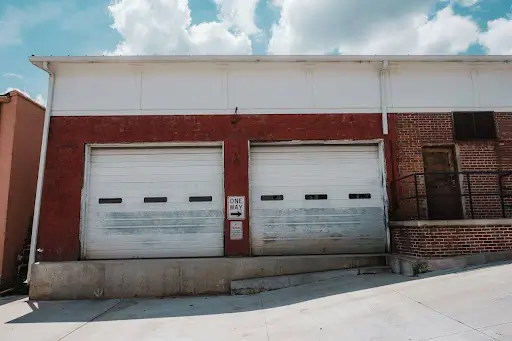
As the last point in the logistics chain, dock doors serve as the last line of defense. These doors are frequently equipped with locking systems and sensors. For example, a dock door may be designed to remain closed until a truck has been secured, preventing “damage on purpose” as a result of an early departure.
In a purpose-built facility, every component from the high-speed door to the heavy-duty leveler is designed to be part of a cohesive system. They turn hits and potential disasters into minor maintenance costs due to smart, sacrificial engineering.