English































































































































































































![swimsuit edition [abbb] - 1.20 21 swimsuit edition - chapter](https://mymagazine.blog/wp-content/uploads/2025/09/swimsuit-edition-abbb-1.20-21-swimsuit-edition-chapter1-1024x574.webp)





This $15 Detail Makes Your Kilt Outfit Look 10x More Expensive (Most Men Skip It)

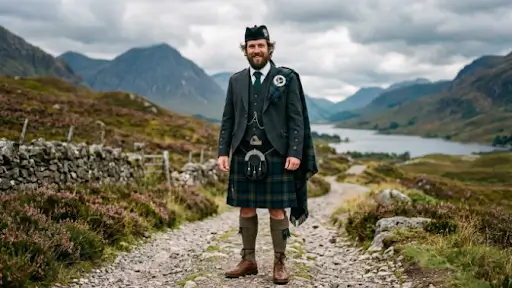
I’ve been to a lot of Scottish-themed weddings, Burns Night dinners, and Highland games over the years, and there’s one detail I notice every single time. It separates the guys who clearly know what they’re doing from the guys who clearly Googled “kilt outfit” the night before.
It’s not the kilt. It’s not the shoes. It’s not even the jacket.
It’s the kilt pin.
This tiny piece of metal — usually 3 to 4 inches long, costing somewhere between $15 and $80 — is the easiest, cheapest way to instantly upgrade how a kilt outfit looks. And yet I’d estimate 60% of first-time kilt wearers skip it entirely. Either they don’t know it exists, they think it’s optional, or they assume it’s purely decorative and not worth the bother.
All three assumptions are wrong. Let me explain why.
What a Kilt Pin Actually Does (Spoiler: It’s Not Just Decoration)
The kilt pin serves a very specific functional purpose, and once you understand it, the design makes complete sense.
The front of a kilt is called the apron — the flat panel that overlays the pleats. On a windy day, that apron has a tendency to flap up. Highland weather being what it is, this happens often. The kilt pin’s original job was to add a small amount of weight to the outer corner of the apron, keeping it stable and preventing accidental exposure.
The pin does not pin the outer apron to the inner apron — that’s the most common beginner mistake. If you pin both layers together, you’ll tear the under-apron’s fabric every time you sit down or walk briskly. The pin only goes through the outer apron alone.
So functionally, it’s a discreet piece of weight. Aesthetically, it’s a focal point. And historically, it’s one of the most personal pieces in your entire kilt outfit.
The Symbolism Most Wearers Don’t Know About
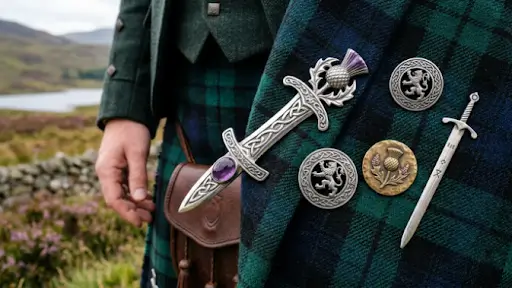
Kilt pins aren’t just generic ornaments. Traditional kilt pins almost always carry meaningful symbolism:
Sword pins
Shaped like miniature claymores or swords. They reference Highland warrior heritage and are the most traditional design choice.
Thistle pins
The thistle is Scotland’s national flower. A thistle pin is the safest universal choice if you have no specific clan affiliation.
Clan crest pins
If you have a specific Scottish clan in your family tree, a clan crest pin lets you wear that heritage explicitly. The crest is a small medallion at the top of the pin showing your clan’s symbol.
Stag pins
The stag is associated with Highland nobility and several specific clans. A popular choice for Scots from the central and northern Highlands.
Saltire pins
Featuring the Scottish flag (St. Andrew’s Cross). Patriotic without being clan-specific.
Celtic knot pins
Interlaced knotwork designs, often blending Scottish and Irish Celtic traditions. Good for those with broader Celtic heritage rather than specifically Scottish.
A man wearing a Mackenzie clan crest pin is making a small but unmistakable statement to anyone who recognizes it. A man wearing no pin at all is making a different statement — usually unintentionally — that says “I haven’t fully thought this outfit through.”
Where Exactly Does the Kilt Pin Go?
This is where many first-timers get it wrong, and the difference is immediately visible.
Correct placement:
- On the outer apron only, never piercing through to the under-apron
- About 2 to 3 inches up from the bottom hem
- About 2 to 3 inches in from the right edge (the open side of the apron)
- The pin should hang vertically, not at an angle
Common mistakes:
- Pinning at the center of the apron (looks like a brooch)
- Pinning too high up near the waist (loses the weighting function)
- Pinning at an angle (looks careless)
- Pinning through both apron layers (tears the fabric over time)
- Wearing it on the left side (the right side is the open edge that needs the weight)
If you imagine drawing a small square 2 to 3 inches up from the bottom hem and 2 to 3 inches in from the right edge, your pin lives in the middle of that square. That’s the spot.
A nicely positioned kilt pin draws the eye exactly where the kilt’s shape is most attractive — at the natural drape point — without competing with the sporran for attention.
Matching the Pin to the Rest of Your Kilt Outfit
The kilt pin is small, but it has to coordinate with everything else metallic in your outfit. Get this wrong and the outfit looks scrambled instead of curated.
Coordinate with:
- Sporran chain — If your sporran chain is silver-tone, your pin should be silver. If it’s antique brass, your pin should be brass.
- Belt buckle — Same metal family
- Jacket buttons — Most kilt jackets use silver, antique pewter, or polished pewter
- Sgian dubh handle — If you’re wearing one, its metalwork should match the pin
Don’t worry about matching:
- Watch (most kilt outfits are formal enough to leave the watch off, but if you wear one, it doesn’t need to match)
- Wedding ring or other personal jewelry
- Tartan colors (the pin shouldn’t match the tartan — it should contrast cleanly)
The general rule: pick one metal family — silver/chrome OR brass/gold OR pewter/antique — and stay within it for everything metallic the kilt outfit displays.
How Much Should You Spend on a Kilt Pin?
Pricing tiers I’d recommend:
$15 to $30
Solid pewter, basic designs (sword, thistle, simple knotwork). Perfectly acceptable for casual wear, ceilidhs, and first-time wearers. The metal won’t tarnish quickly and the designs are timeless.
$30 to $80
Higher-grade pewter, sterling silver-plated, antique-finished pieces, or simple clan crest pins. This is the sweet spot for wedding wear and formal events.
$80 to $200+
Solid sterling silver, semi-precious stone inlays, hand-engraved clan crests, or limited-edition designs. For men who wear kilts frequently and want a piece that becomes a personal signature.
Anything above $200 enters heirloom territory — pieces designed to be passed down. There’s nothing wrong with that, but you don’t need it for a great-looking outfit.
The honest truth: a $25 pewter sword pin, well-positioned, will look better than a $200 silver pin that’s pinned in the wrong place.
Why Most Men Skip It (And Why That’s a Mistake)
Three reasons men skip the kilt pin:
1. They don’t know it’s a thing.
Many guys learn about ghillie brogues, sporrans, and kilt hose before they ever encounter the kilt pin. By the time they hear about it, they assume their outfit is already complete.
2. They think it’s purely decorative.
Once you understand the functional weighting purpose, the pin stops feeling optional. It’s like the buckle on a belt — technically you could skip it, but the design isn’t really finished without it.
3. Decision fatigue.
After researching kilts, sporrans, jackets, and shoes, the kilt pin feels like one detail too many. Many men just shrug and skip it.
But here’s what they don’t realize: of all the pieces in a kilt outfit, the pin has the highest visual return on investment. A $25 pin draws more positive attention than the $80 sporran sitting right next to it. It’s the closest thing kilt wearing has to a wristwatch — small, elegant, instantly noticed by people who know what to look for.
When You Can Actually Skip the Kilt Pin
There are a few legitimate situations where skipping is fine:
- Highland games athletic events where you’re competing physically and don’t want a pin to catch on equipment
- Pipe band performances if your specific band’s uniform regulations prohibit personal additions
- Modern utility kilts or alternative kilt styles where the pin doesn’t fit the aesthetic
- Casual everyday kilt wear where you’ve intentionally chosen a stripped-down look
For traditional Scottish dress at any formal or semi-formal occasion, skipping the pin reads as incomplete.
Building the Pin Into Your Existing Kilt Outfit
If you already own a kilt outfit and you’re adding a pin retroactively, here’s the simple upgrade path:
- Choose a pin design that suits the formality of your most-worn occasion
- Match the metal to your existing sporran chain
- Practice positioning it before the actual event — pin and unpin it a few times so you’re comfortable
- Wear it for a full event and notice the difference in how the kilt hangs
You’ll likely find the kilt itself sits better with the pin in place. That weighting function is real, and on windy outdoor events, you’ll be glad it’s there.
Frequently Asked Questions
Do I pin through both layers of the kilt apron?
No. Only through the outer apron. Pinning through both layers tears the under-apron over time and isn’t traditional.
What’s the most universally appropriate kilt pin design?
A simple thistle or sword pin in pewter or silver. Both work for any clan, any tartan, and any formality level.
Can I wear a kilt pin with a non-tartan kilt like a leather kilt or utility kilt?
You can, but it’s less traditional. Many leather and utility kilts are styled without pins. If you want to add one, choose a more modern design rather than a clan crest or claymore-style pin.
Where do I buy quality kilt pins?
Specialist kilt retailers, Scottish heritage stores, or online from kilt-focused brands. Avoid generic accessory shops where “kilt pin” listings are often safety pins or oversized brooches mislabeled.
Does the kilt pin need to match my tartan colors?
No. It should match the metals elsewhere in your outfit (sporran chain, buckle, buttons). Trying to match the tartan colors usually results in a mismatched look.
Can I inherit a vintage kilt pin?
Absolutely — and many men do. Vintage clan crest pins or hand-engraved heirloom pieces are some of the most meaningful kilt pins to wear. Just have any old hinges or clasps inspected by a jeweler before wearing it to an event.
A kilt pin is the smallest piece in a kilt outfit and one of the highest-impact ones. Skip it and your outfit looks like a costume. Add it — placed properly — and the entire look reads as deliberate, polished, and traditional. Fifteen dollars, two minutes of effort, and a permanent upgrade to every future kilt event.